
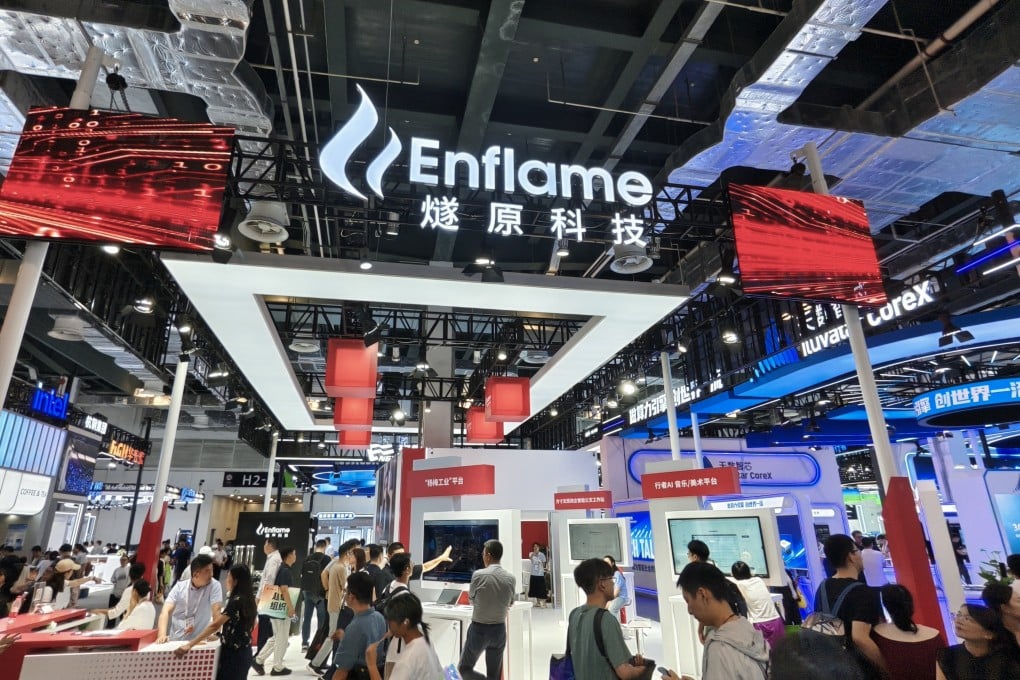
 Tencent-backed company valued at US$25 billion, highlighting its role in Beijing’s push for domestic chips amid US export restrictions
Enflame Technology, one of the major challengers to Nvidia in China, saw its share price surge 179 per cent in its Shanghai trading debut on Friday, giving the Tencent Holdings-backed artificial intelligence chipmaker a market capitalisation of 170.9 billion yuan (US$25.5 billion).
The Shanghai-based company opened at 410 yuan, up from its issue price of 142.18 yuan. It surged as much as 234 per cent to 475 yuan during the day, before closing at 397 yuan. The performance reflects continued investor appetite for domestic AI chip champions, with Enflame being the last of China’s “four little dragons” in the sector to go public.
Enflame’s gains stood out against the broader market on Friday. The Star 50 Index fell 1 per cent, while the benchmark CSI 300 Index dropped 0.8 per cent.
Do you have questions about the biggest topics and trends from around the world? Get the answers with SCMP Knowledge, our new platform of curated content with explainers, FAQs, analyses and infographics brought to you by our award-winning team.
Enflame raised about 6.12 billion yuan by selling 43.04 million shares. The offering valued the firm at about 61 billion yuan before trading began, making it one of the largest tech listings in mainland China this year.
The retail portion of its initial public offering (IPO) was oversubscribed by 4,073 times, with about 7 million online investors submitting orders for 42.1 billion shares. The allocation rate for individual investors was just 0.025 per cent, one of the lowest on the mainland market this year.
The strong market response highlights Enflame’s role – alongside peers Moore Threads, Biren Technology and MetaX Integrated Circuits – in Beijing’s push for semiconductor self-sufficiency as the US restricts exports of advanced chips from global leaders such as Nvidia.
Early stakeholders saw their paper wealth soar following the blockbuster debut. The stake of Tencent, Enflame’s largest institutional backer, rose 20 per cent to nearly 35 billion yuan.
Other prominent investors include memory chipmaker GigaDevice, smartphone and electric vehicle maker Xiaomi, chip packaging firm Tongfu Microelectronics, and telecommunications giant ZTE.
Enflame’s first-day performance trailed its peers MetaX and Moore Threads, which were among the first domestic AI firms to list in a wave that started last year. Driven by the global AI frenzy, the two companies saw first-day pops of 693 per cent and 425 per cent, respectively, in their debuts on the tech-focused Star Market in December.
Founded in 2018, Enflame has rapidly scaled its business on surging domestic demand for AI computing power.
Unlike Nvidia and its three domestic peers – which focus on general-purpose graphics processing units (GPUs) capable of handling a wide range of workflows – Enflame has staked its future on domain-specific architecture (DSA), which the company said is an advanced evolution of application-specific integrated circuits.
The company expected revenue to reach between 2.3 billion and 3 billion yuan in the first nine months of 2026, a year-on-year jump of up to 455 per cent, according to its prospectus. However, Enflame remains unprofitable as it continues to pour capital into research and development.
Chairman Zhao Lidong said the company was on track to turn a profit as early as this year.
“Considering our orders on hand, product delivery schedules, staff cost budgets and R&D planning, we expect to achieve consolidated profitability in 2026 or 2027,” Zhao said during the company’s IPO roadshow earlier this month.
More Articles from SCMP
Chinese school restricts students to 1 bathroom break per term during class, sparks probe
This Leslie Cheung 70th birthday exhibition offers an intimate look at the Cantopop star
Vance takes centre stage as Trump wraps up GOP midterm convention with voter warnings
New York Fashion Week 2026: Tory Burch brings vibrant spring collection to Isamu Noguchi’s Sunken Garden
This article originally appeared on the South China Morning Post (www.scmp.com), the leading news media reporting on China and Asia.
